Table of Contents
Wasabi
Wasabi brands itself as “hot storage” with full compatibility with the popular S3 standard. It’s designed as a budget-friendly rival to giants like AWS S3, aiming to deliver reliable performance without emptying your wallet. For businesses that want to cut costs on cloud storage while keeping things running smoothly, Wasabi offers a compelling option.
Simplicity is key here. Wasabi strips away confusing fees and complicated pricing models, focusing instead on straightforward, predictable costs. The absence of egress fees means you can move data when you want, without the nasty surprise bills later. This makes it especially attractive for workloads that involve moving large amounts of data.
Security doesn’t take a backseat. Wasabi provides data immutability to keep your information tamper-proof, plus strong access controls that tighten who can see what. And as your business grows, Wasabi scales smoothly, handling increased storage needs without breaking a sweat.
Data durability is another plus. By replicating your data across multiple data centers, Wasabi ensures your files are always available, even if one facility runs into trouble.
Key Features
- Affordable pricing with no egress fees - perfect for data-heavy projects.
- Robust security with data immutability and detailed access controls.
- Scalable storage solutions that grow with your business needs.
- High availability through multi-data center redundancy.
Looking for alternatives? Below you’ll find the top 7 Wasabi competitors in cloud storage - because sometimes, variety is the spice of data life.
Benefits
Scalability
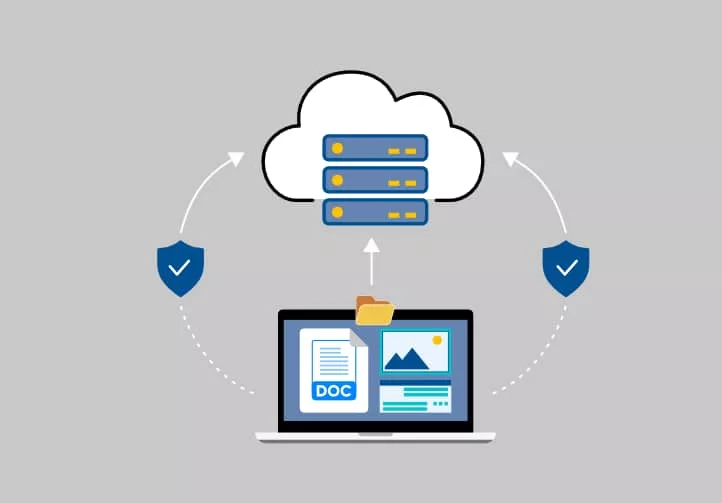
Rabata’s cloud storage handles data like a pro, scaling effortlessly from a few gigabytes to mind-boggling exabytes without breaking a sweat. You add data, it grows; you delete data, it shrinks. No complex setup or storage guessing games. Just pure elastic storage that bills you only for what you actually use.
Durability and availability
Imagine a vault so secure it’s almost impossible to lose your data. That’s what Rabata’s cloud storage delivers. Built on a unique, battle-tested architecture, it guarantees data durability measured in 11 nines - yes, that’s 99.999999999%. And if you expect downtime, think again. With 99.99% availability, your data is ready when you are, backed by some of the toughest cloud service agreements out there.
Security and data protection
Rabata takes data security seriously, like a bodyguard who never sleeps. Your files are always private, encrypted by default, and guarded with strict access controls. Plus, it offers detailed auditing tools so you can keep an eye on who’s poking around your storage. Compliance and protection? Covered.
Lowest price and highest performance
Why pay more for less? Rabata combines affordability with speed and resilience. Multiple storage tiers let you choose whether your data needs to be lightning fast or more budget-friendly. Automated lifecycle management moves data seamlessly between these tiers - no hassle, no extra cost. This means you get the best performance without your wallet taking a hit.
Key Features That Set Providers Apart
Mounting Cloudflare R2 storage using S3FS isn’t always a walk in the park. While R2 boasts full compatibility with the S3 API, users have sometimes hit snags trying to mount R2 buckets with S3FS, leading to frustrating head-scratching moments and bug hunts.
Cloudflare R2 classifies operations into two categories: Class A and Class B. Class A covers actions like PUT and POST - basically, anything that writes or modifies data. Class B includes operations such as GET, which are all about reading or retrieving data. This sorting helps in tracking usage and costs more clearly.
Good news for users: inbound data transfer is completely free across all storage types in Cloudflare R2. Upload as much data as you like without worrying about surprise fees sneaking up on you.
Retrieval time from Cloudflare R2 depends heavily on the cluster's setup. Various factors like network speed, hardware quality, and storage layout all play their part. Sometimes, the data flies to you fast, and other times it takes a scenic route.
Migrate Your Workloads to DigitalOcean
Looking to slash your cloud expenses by 30 to 50 percent without sweating over the details? Rabata offers expert guidance that covers your entire migration journey at zero extra cost. Imagine joining the ranks of savvy companies like PiCap, Tango, and NoBid, all of whom moved their workloads to DigitalOcean and saw their infrastructure bills shrink significantly in just a few months.
With Rabata’s support, you get clear, no-nonsense pricing, generous bandwidth limits that keep your projects humming, and complimentary access to cutting-edge GenAI resources. It’s everything you need to make the switch smooth and rewarding.
Ready to make the leap? Start your migration today and watch your cloud costs drop while your efficiency soars.
Conclusion
Managing S3 storage is not just about dumping files into a bucket and hoping for the best. It’s a smart dance involving cost control, rock-solid security, smooth performance, and careful lifecycle management.
As your storage needs grow, keeping track of everything and maintaining control starts to feel like juggling flaming torches. The complexity doesn’t just increase - it multiplies.
To tackle this, Rabata’s approach combines automation that thinks ahead, strict policy enforcement like a disciplined bouncer, and seamless integration with your overall infrastructure. The result? Data that’s not only secure and organized but also managed without headaches across all environments.
Frequently asked questions
Wondering where you can stash your data with Rabata's Object Storage? Right now, you can safely deposit your files in Falkenstein, Germany (FSN1), Helsinki, Finland (HEL1), and Nuremberg, Germany (NBG1). These locations are strategically chosen to offer you fast, reliable, and secure access no matter where you are in Europe.
How much space do you get? Think of Rabata’s Object Storage as having up to 100 buckets floating in the cloud, ready to catch up to 100 terabytes of your precious data each. That's 50 million individual objects per bucket! Whether you’re hoarding photos, videos, or critical business docs, there’s plenty of room to roam.
Let’s talk money - Rabata keeps it straightforward with a base price of €4.99 per month (excluding VAT). This covers 1 terabyte of storage, or up to 744 terabyte-hours, and 1 terabyte of egress traffic. Going past that? No sweat. You just pay-as-you-go, making sure you only spend on what you actually use without any nasty surprises.
Pay-as-you-go means just what it says. If you’re an active bucket owner, Rabata charges by the hour - even if your bucket's as empty as your coffee mug on a Monday morning. The billing clock ticks for every hour you have at least one bucket alive, weighing your storage amount and traffic to keep costs fair and flexible. It's billing that plays nice with your usage.
Talking hourly rates, the base price is €0.0081 per hour (or \{ai-content}.0096), with a friendly cap of €4.99 (\.99) a month. So no matter how many hours your bucket hangs out, the monthly fee won't surprise your wallet. This model ensures you only pay for the actual time your data lives on Rabata’s platform.
Not all traffic costs you extra - Rabata’s got your back. Uploading data into your storage, internal traffic within the EU Central network zone, and commonly used S3 API calls like PUT, GET, or DELETE come at zero cost. So feel free to organize, modify, or upload without blinking at your bill.
- Ingress traffic (data uploaded to the storage)
- Internal traffic within the eu-central network zone
- S3 API calls such as PUT, GET, or DELETE requests
Thinking about saving your unused quota for a rainy day? Sorry, that’s not how Rabata’s cloud works. Any leftover storage or traffic quota expires at the month’s end, encouraging you to optimize your usage each billing cycle.
Exceed your included quota? Rabata only asks for a bit extra to keep the cloud running smoothly. Storage overages are charged at €0.0067 (or \{ai-content}.0080) per terabyte-hour, while extra egress traffic will cost €1.00 (or \.20) per terabyte. Precision matters here - all calculations round to four decimal places to keep billing crystal clear.
- Storage: €0.0067 / \{ai-content}.0080 per TB-hour
- Egress traffic: €1.00 / \.20 per TB
- Billing precision to four decimal places (e.g., 1.2345 TB)
And a quick but important clarification: that included quota is not per bucket but across all your buckets combined. So juggling multiple buckets won't multiply your free allowance but will give you neat compartmentalized storage within the same overall limit.
Curious how Rabata measures your storage consumption? It’s all about TB-hours. Imagine storing 1 TB for 1 hour - that's 1 TB-hour. If you double the size or the time, you multiply the TB-hours accordingly. This clever metric balances size and duration, giving you a fair, flexible way to track usage over time.
A heads-up for small object lovers: if your data pieces smaller than 64 KB, Rabata rounds up for billing purposes. A tiny 10 KB object counts as 64 KB when it comes to costs. Storage banks might handle small files, but billing plays by its own size rules.